Kashima-san
The Character of RainKashima-san is the narrator’s second Japanese nanny, hired when the narrator’s growing demands lead the parents to seek additional help for Nishio-san. Around fifty and formerly a princess, she carries into the household a history of rank and loss: the old Japanese nobility to which she belonged was abolished by the Americans in 1945, and she was left without either her title or her money. Her brief appearances place that fallen status beside the practical work of caring for a child, while showing her as a figure whose bearing differs markedly from that of the first nanny.
Background and Arrival
The narrator’s parents hire a second nanny because the narrator has become so demanding that Nishio-san needs help. They place an announcement in the village, and Kashima-san enters the family’s life through this practical arrangement. The account does not present her arrival as a replacement for Nishio-san: she is specifically described as the second nanny, brought in to assist her.
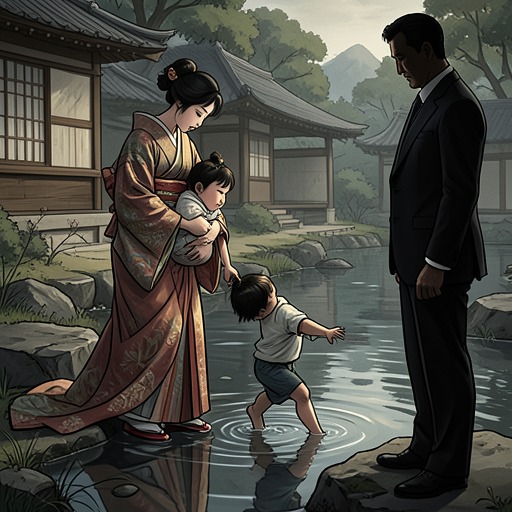
Kashima-san’s personal history gives the new household arrangement an unexpected social dimension. She is around fifty and had been a princess for nearly thirty years, before the abolition of the nobility left her without title or money. The contrast is pointed but understated: someone raised within an aristocratic world now works as a nanny. The narration offers these details as part of her identity, without explaining how she came to take the position or how she regards that change.
Contrast with Nishio-san
The narrator defines Kashima-san partly through comparison with Nishio-san. Nishio-san is young, gentle, and sweet, but described as neither pretty nor prosperous; Kashima-san, by contrast, is around fifty, beautiful in an aristocratic way, and of aristocratic background. Their differences are presented as more than matters of age or appearance. They bring sharply distinct social histories and demeanors into the same caregiving arrangement.
That contrast also shapes Kashima-san’s introduction. The family needs more help because of the narrator’s behavior, but the person recruited to provide it is not another version of Nishio-san. Kashima-san arrives with a past marked by lost privilege and a bearing the narrator associates with her former rank. The account establishes this difference without claiming that it determines how she cares for the child or how the two women relate to one another beyond the shared household role.
Authority and Conflict
A later passage brings Kashima-san into a conflict over discipline and the narrator’s authority. The narrator considers whether Kashima-san had the right to strike her simply on the grounds that this was her way of behaving. Rather than accepting that explanation, the narrator treats the incident as an affront and connects the dispute to the protection of her religion, threatening consequences for anyone who challenges it. The episode thus presents the narrator’s developing sense of power through a confrontation with an adult caregiver.
The account gives the narrator’s judgment and response, not Kashima-san’s explanation of the incident. Kashima-san’s own view is therefore not established in this passage. What is clear is that the narrator refuses to regard an adult’s habitual conduct as sufficient justification for the treatment she objects to. Her response turns a question about a nanny’s authority into a declaration of religious and personal authority, revealing the conflict’s importance to the child who recounts it.
Presence in Later Scenes
Kashima-san is also observed in a scene where a woman weeps but does not change her mind. The narrator notices Kashima-san smiling quietly. The passage does not identify the reason for the smile or establish that it is directed at the woman, so it remains a small, carefully reported detail rather than a full account of Kashima-san’s motives. Its effect is to place her composed expression beside another person’s visible distress without explaining the contrast away.
Across these moments, Kashima-san is defined through a few distinct points of contact: her former royal status, her work alongside Nishio-san, a conflict over discipline, and her quiet smile in a scene of resolve and tears. The narration supplies no complete account of her life after the loss of her title and money, nor a final resolution to her relationship with the family. Her role is instead marked by contrast and partial observation: she enters as a practical answer to the narrator’s demands, but her history and presence make her more than a simple counterpart to the younger, gentler Nishio-san.